Playbook 07 · New relationships
Someone has just started a target role within the last thirty days, carrying a fresh mandate, an unspent budget, and a vendor list that is still genuinely open. Reach them in month one and you become the default that everyone else gets compared against. Arrive in month three and you are the comparison.
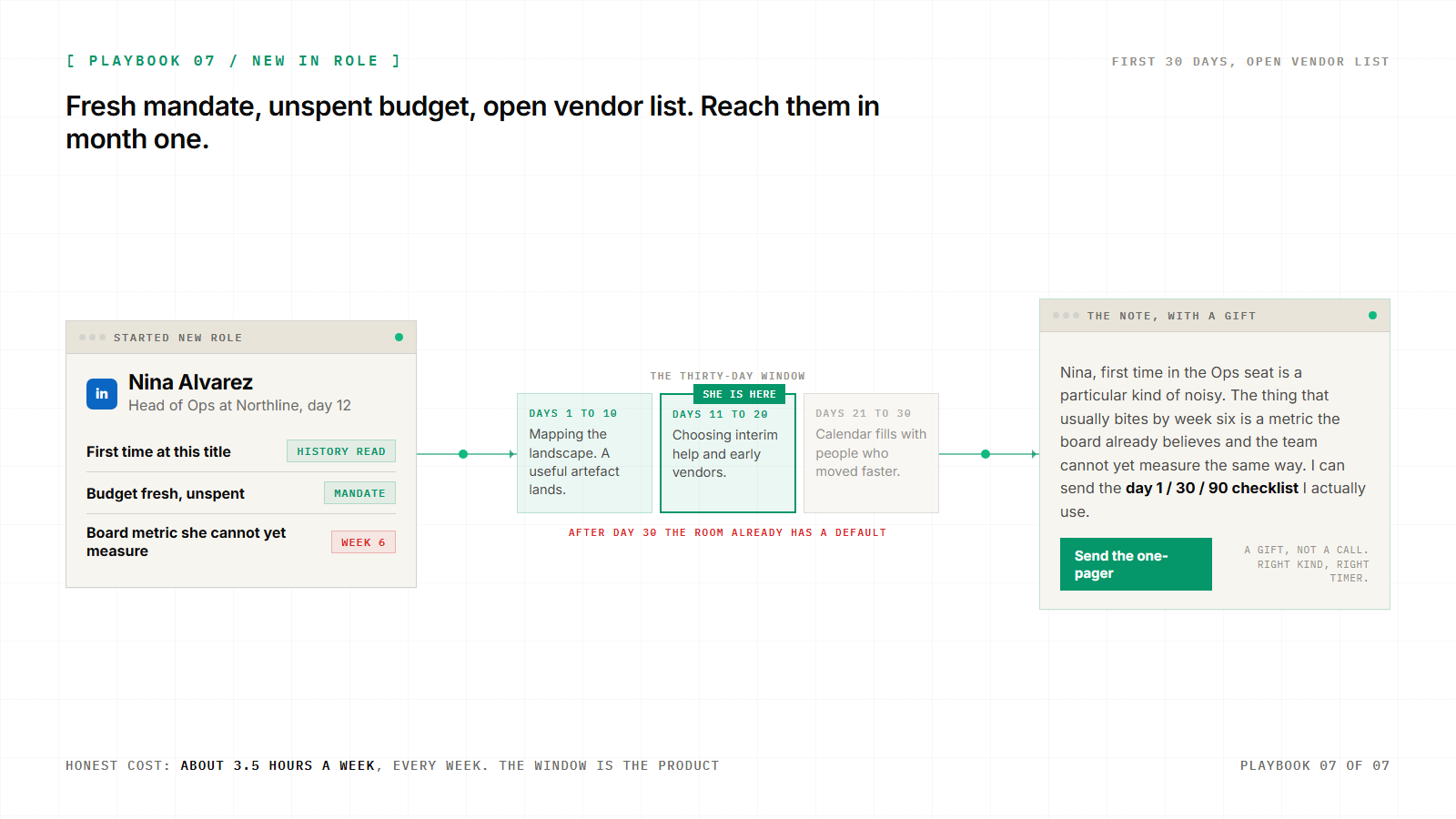
Playbook 07 / first 30 days, open vendor list
| Who it targets | Newly appointed Heads, VPs, Directors, and sometimes CXOs in the seats that buy your work. Strangers until you write. |
| The signal | Job change in last 30 days into a target title at a company that matches your client type. |
| Where it is visible | LinkedIn “pleased to announce” posts, Sales Navigator job changes, company announcements, sometimes press. |
| Time cost | ~180 hours a year at a serious weekly cadence (about 3.5 hours a week). Watch, history read, waterfall, draft, send, one follow-up. The background read is still the part everyone skips. |
The playbook splits in two
First-timer in the seat
Their first Head of, VP, or Director title. They are learning the function on the job. They need frameworks, peer benchmarks, and someone who has walked the same first 90 days. Your offer is mentorship and a fast-track playbook. Tone: calm, generous, specific.
Experienced leader, new company
Their third or fourth time in a seat like this. They know the patterns. They are short on time, not knowledge. Your offer is execution capacity and a peer to compare notes with. Tone: peer-to-peer, no tutorials, no “how to be a CMO” energy.
Those are two completely different messages for two genuinely different people, and this is precisely why the twenty-minute history read matters. The operators who skip it end up sending the wrong gift half the time, watch their reply rate collapse, and then conclude that the channel is dead, when the only thing that was ever dead was the targeting.
How to run it
Step 01: Watch for role changes every week.
Same monitoring discipline as the tradecraft chapter: saved search or Sales Navigator “changed jobs in last 30 days,” title list under eight strings, size and geography filters, fixed weekly review. Manual path: twenty minutes on “started a new position” language in your feed. Not a quarterly binge.
Step 02: Verify it is a real promotion into power.
Same company title bump with no new budget is weaker than a move into a new company with a mandate. Interim labels need care. Acting heads sometimes cannot buy. Confirm the company matches your client type before you invest in a deep read.
Step 03: Read full employment history to choose first-timer vs veteran.
Count prior seats at this level. Note industries. Note whether they have bought external help before if you can see it from their path. This step is twenty quiet minutes and it is the difference between a reply and a polite delete.
Step 04: Name their first-month problem.
The marketing leader needs a written plan by week six. The ops leader inherits a metric they cannot yet measure. The finance leader has a board date they did not set. If you cannot name a first-month problem, you are not ready to write.
Step 05: Waterfall, then reach out with the right gift for their kind.
Tradecraft stages 5 and 6 cover the address, the channel, the log, and the single follow-up. First-timer gift: a 90-day checklist, a benchmark, a “here is what good looks like by day 45.” Veteran gift: a peer observation, a risk you see in companies like theirs, an offer to be a sharp second brain for one decision. Always give them a way to say yes that is smaller than a sales call.
What to say
First-time Head of Ops / day 12
Nina, saw you step into the Head of Ops seat at Northline. First time at that title is a particular kind of noisy. The thing that usually bites by week six is a metric the board already believes and the team cannot yet measure the same way.
I put new ops leaders through a 90-day operating rhythm for companies your size. I can send the day-1 / day-30 / day-90 checklist I actually use (one page). No call required unless you want one after.
Third-time VP Marketing / day 9
Chris, third marketing seat, new logo, same first-month tax: everyone wants a plan before anyone will admit which numbers are lies. I work as fractional / project support behind VPs who already know what good looks like and need execution without a six-month hiring cycle.
If useful, I will send two questions I ask in week one that surface whether the hole is demand, conversion, or story. Peer note, not a pitch sequence.
~180 hrs / year. About 3.5 hours a week, every week. Watch, verify, read history, waterfall, write, send, one follow-up. The background read is the bit everyone skips, which is exactly why their messages land wrong half the time. Do not “batch a quarter” of these in a Sunday panic. The window is the product.
How this playbook fails
- You congratulate and pitch in the same sentence, which is pure seller status. Delete.
- You treat first-timers and veterans as one persona.
- You arrive in month three with month-one energy.
- You skip company fit and message every new VP in your feed.
- You offer a “quick call” with no gift, which asks for their time without earning it. Busy people need a reason.
The thirty-day window, in practice
Days 1–10: the new leader is still mapping the landscape. A useful artefact lands. Days 11–20: they are choosing interim help and early vendor conversations. Days 21–30: calendars fill with people who moved faster than you. After day 30 you can still win, but you are walking into a room that already has a default. That is why the weekly watch matters more than a heroic monthly binge. Miss two weeks of scanning and you are permanently late to a rotating set of buyers.
Keep the standing monitor alive even when delivery is heavy. Forty-five minutes of standing watch plus two fully researched notes beats two quiet months and a Sunday panic when the retainer ends.