 Move Who this edition is for
Open Who this edition is for
This is the web edition of 7 Playbooks To Build Your Pipeline, published here for the partners and practice leads of boutique consulting firms.
The book was first written for consultants who carry their own pipeline. Most boutique firms work the same way underneath: every partner has a network, every partner is busy delivering, and new work still arrives through a handful of relationships and good timing. The playbooks translate directly. Each partner can own one playbook, run it by hand on their own network, and report what it surfaced at the weekly pipeline meeting.
Read the first five chapters before you touch a playbook. The playbooks only work once you believe two things: that the conversations are already out there waiting for you, and that reaching for them costs you nothing in status. The tradecraft chapter at the back holds the machinery for running everything by hand.
What you will leave with: one playbook your firm can run on a Tuesday afternoon. Real steps. Real hours. Real messages.
Who this edition is for
169 words
Move You are not short of conversations. You are drowning in them.
Open You are not short of conversations. You are drowning in them.
Preface
The quiet before the scroll
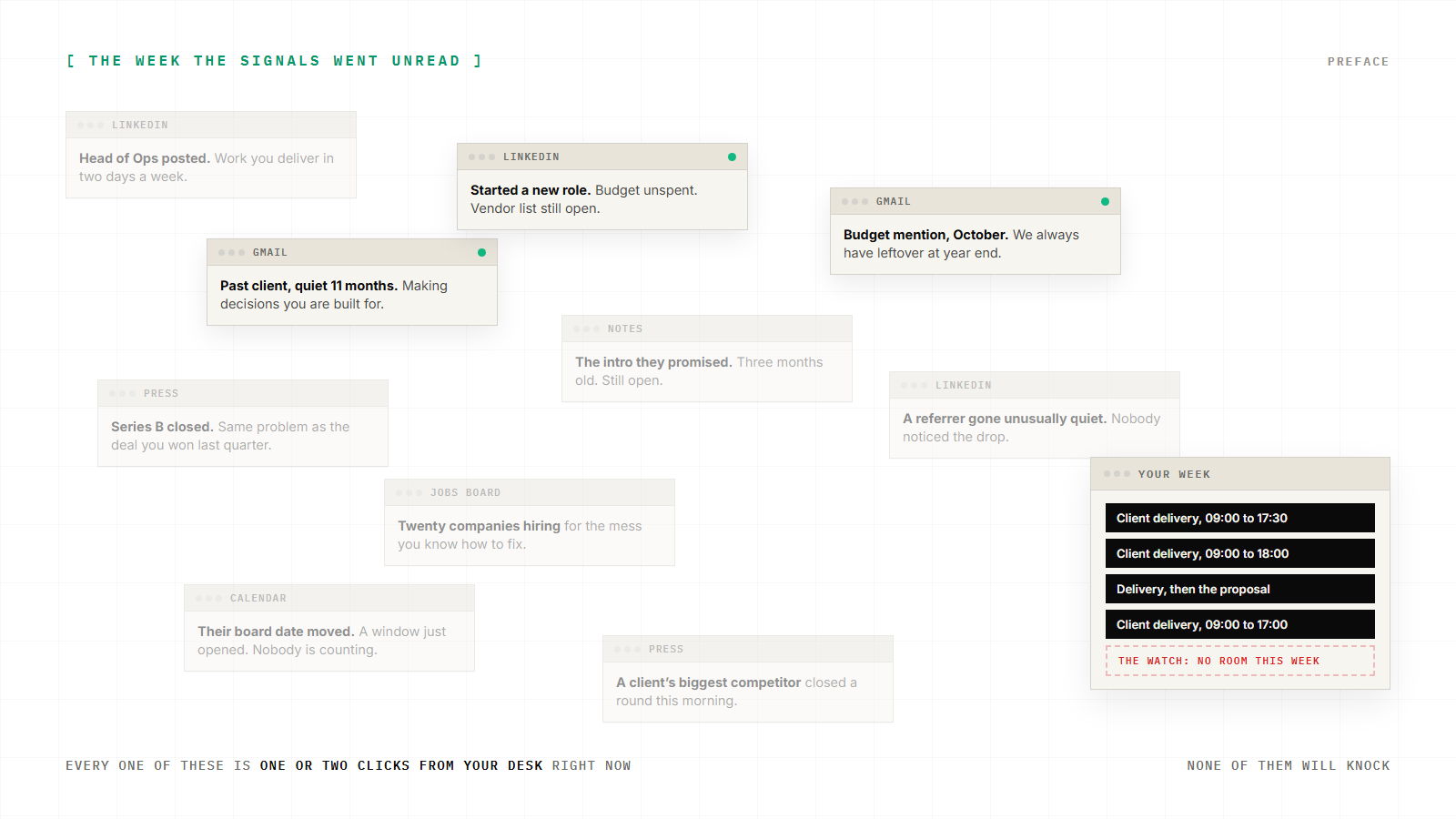
You already know the feast-famine pattern, because you have lived through it more than once. Delivery fills the calendar, the pipeline work slips quietly to the bottom of the list, and then a retainer ends. The calendar that looked so healthy in March is a ghost town by May, and suddenly LinkedIn is open again and the scroll has started.
That hangover is real, and this book takes it seriously. But the hangover is not the point. The point is what it feels like to operate the other way round: to see the next conversation forming before the calendar empties, and to know exactly who to contact, why this week matters to them, and what to say, without ever sounding like you are hunting for scraps. That calm is not a personality trait some consultants are born with. It is the output of a system, and systems can be built.
You are not short of conversations. You are drowning in them.
Think about what is already sitting within re
You are not short of conversations. You are drowning in them.
477 words
Move But I don’t really have a network.
Open But I don’t really have a network.
The objection that stops most people
If your honest reaction to all of this is the opposite of guilt, if what you actually thought was “but I don’t really have a network,” then good. You are exactly who this chapter is for. Read the list again, slowly this time.
Only the first item on it, the clients you have gone quiet on, needs an address book at all. The companies hiring full-time, the leaders starting new roles, the twenty businesses carrying the same problem your last client had: none of those people are in your contacts, and here is the part that changes everything, they do not need to be.
They are broadcasting their need in public, this week, for anyone who has learned how to read it. Six of the seven playbooks in this book build a pipeline from people you have never met. And they reveal something that surprises almost everyone who tries them: a first message to a stranger, sent in the same week their need went public, lands warmer than a “just checking in” note to someone you have ignor
But I don’t really have a network.
843 words
Move If I go looking for work, I look like I need it.
Open If I go looking for work, I look like I need it.
The objection that stops the rest
Even after the network objection falls, another one usually stays standing. It is quieter. It is the one that lets you finish this book, agree with every playbook, and still send nothing.
In your own words it sounds like this: If I go out looking for work, I look like I need it. Experts get sought out. Chasing makes me look available, and available is cheap.
That is not vanity, and it deserves to be treated with more respect than most sales advice gives it. For someone who sells trust, status genuinely is the product, and looking available feels like discounting the only asset you cannot buy back once you have spent it: your reputation. So when a role posts, or an ex-client goes quiet, the move that feels professional is to wait, to post something useful, to hope a referral arrives, and to keep the posture of the person who is in demand. The problem is what that waiting quietly costs you, which is the subject of this chapter.
You were right about the outreach y
If I go looking for work, I look like I need it.
784 words
Move You can’t out-volume the market. You can only out-time it.
Open You can’t out-volume the market. You can only out-time it.
The frame
The consultants who tried to win by shouting louder have already lost, because shouting louder is what HubSpot and Salesforce were built to industrialise, and even the companies running those machines are finding that the room has stopped listening.
You do not sell volume, and this distinction shapes everything that follows. You sell expertise to people who already half-trust you, or who will half-trust you in the week their need goes public, inside the narrow window when they are genuinely ready to buy. Miss the window and the quality of your work never even enters the conversation.
Which means you grow by showing up at the moment a real decision is taking shape, carrying the context that proves you have solved this exact problem before, in front of the person who actually makes the call. Cold outreach cannot do this for you, because it spends the trust you took years to build. Mass content cannot do it either, because it blends you into everyone else who is also posting. The only thing th
You can’t out-volume the market. You can only out-time it.
753 words
Move Your growth problem isn’t leads. It’s the surfacing gap.
Open Your growth problem isn’t leads. It’s the surfacing gap.
The insight
You think you have a lead problem, but you do not. What you have is one constrained resource, your attention, and a brutal rule that governs how it gets spent.
The rule is this: when you are serving clients you are not finding them, and when you are finding them you are not serving. Each feast funds the famine that follows it, and each famine panics you back into taking whatever work appears. The wheel turns, it never lets you off, and no amount of working harder changes its shape, because the problem was never effort.
It is worth saying again, because the guilt runs deep in this profession: you were not lazy, and you were not weak-willed. You were given the wrong system for the job and then judged, mostly by yourself, for the system's failures. Beyond that, there is a structural truth that should take the remaining weight off your shoulders. Stitching five disconnected signal sources together by hand, every single week, while also delivering client work at full intensity, is close to imp
Your growth problem isn’t leads. It’s the surfacing gap.
546 words
Move How to use this book
Open How to use this book
Method
Do not try to run all seven playbooks, however tempting the ambition feels on a quiet Sunday. The hard part of this work is discipline rather than choice, so choose one playbook, run it properly for a full quarter, and ignore the rest until that quarter is over. One playbook run consistently will outperform four playbooks run in bursts, every single time.
Where to start
If you have years of relationships gone cold, start with Playbook 01, Network Sprint. The data is already in your LinkedIn account and the work is mostly remembering.
If your network feels thin, and that is the very thing keeping you up at night, start with one of the hiring playbooks (03–06). The budget is already approved, the need is public, and the buyer is a stranger you are genuinely allowed to help.
If you closed a strong engagement in the last six months and can still name the sentence that made the client hire you, start with Playbook 02, Won Deal Lookalikes.
If you sell to senior operators who change
How to use this book
479 words
Move Playbook 01: Network Sprint
Open Playbook 01: Network Sprint
Playbook 01 · Existing relationships
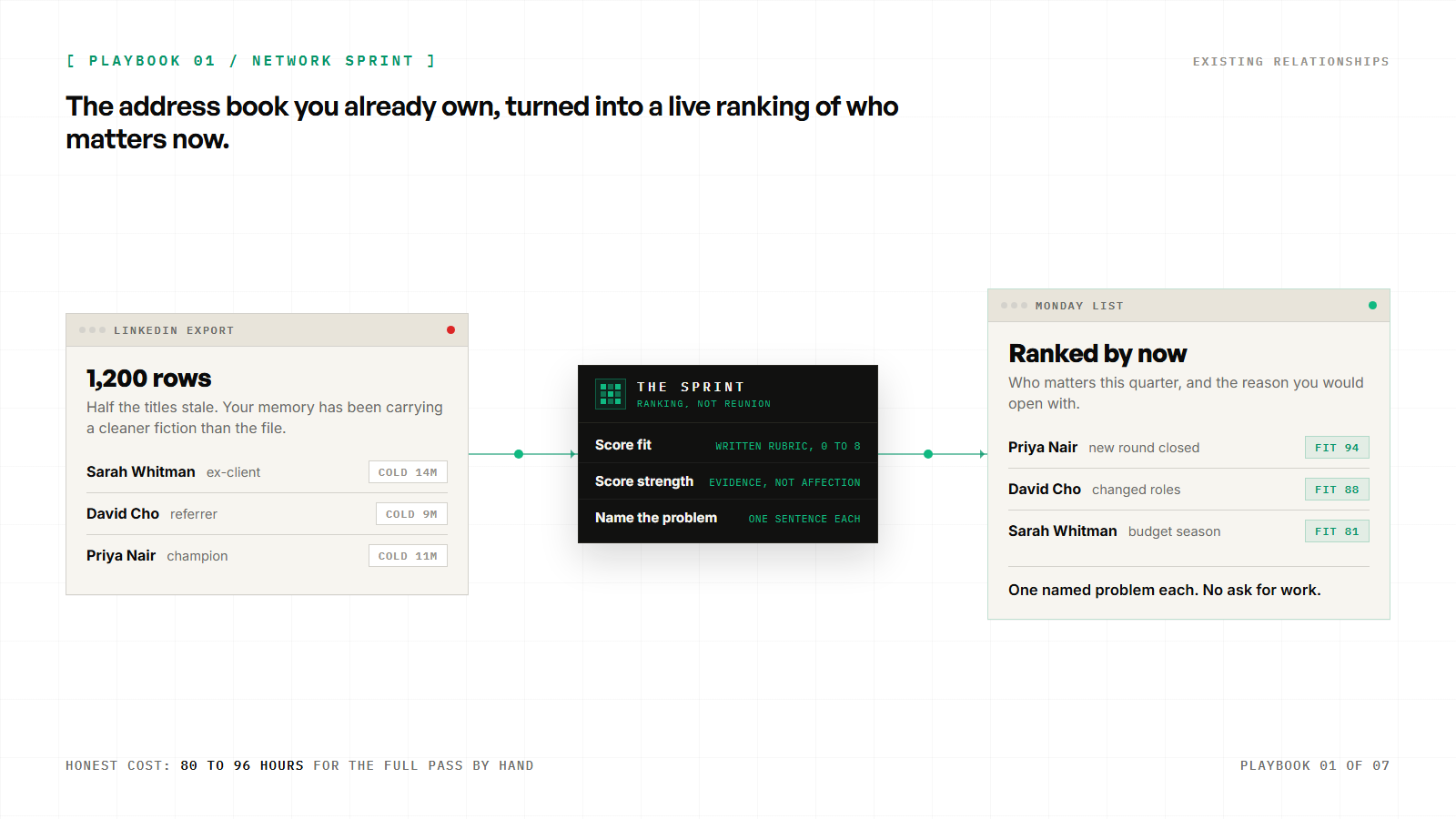
There are twelve hundred people in your network, and perhaps sixty of them are ready for a real conversation this quarter. The trouble is that you have not spoken to most of them in over a year, and you have no way of knowing which sixty they are. This playbook turns the address book you already own into a live ranking of who matters right now, why they matter, and what you would open with.
Playbook 01 / existing relationships
|
|
| Who it targets |
Past clients, referrers, peers, and warm contacts already in your LinkedIn graph or inbox who match your ideal client or sit one step from one. |
| The signal |
High fit + relationship decay. They still look like a buyer (or a path to one), and you have gone quiet long enough that recency has died. |
| Where it is visible |
LinkedIn Connections.csv, your Gmail search history, calendar of past meetings, and any notes you still have from past work. |
|
|
Playbook 01: Network Sprint
1,322 words
Move Playbook 02: Won Deal Lookalikes
Open Playbook 02: Won Deal Lookalikes
Playbook 02 · New relationships
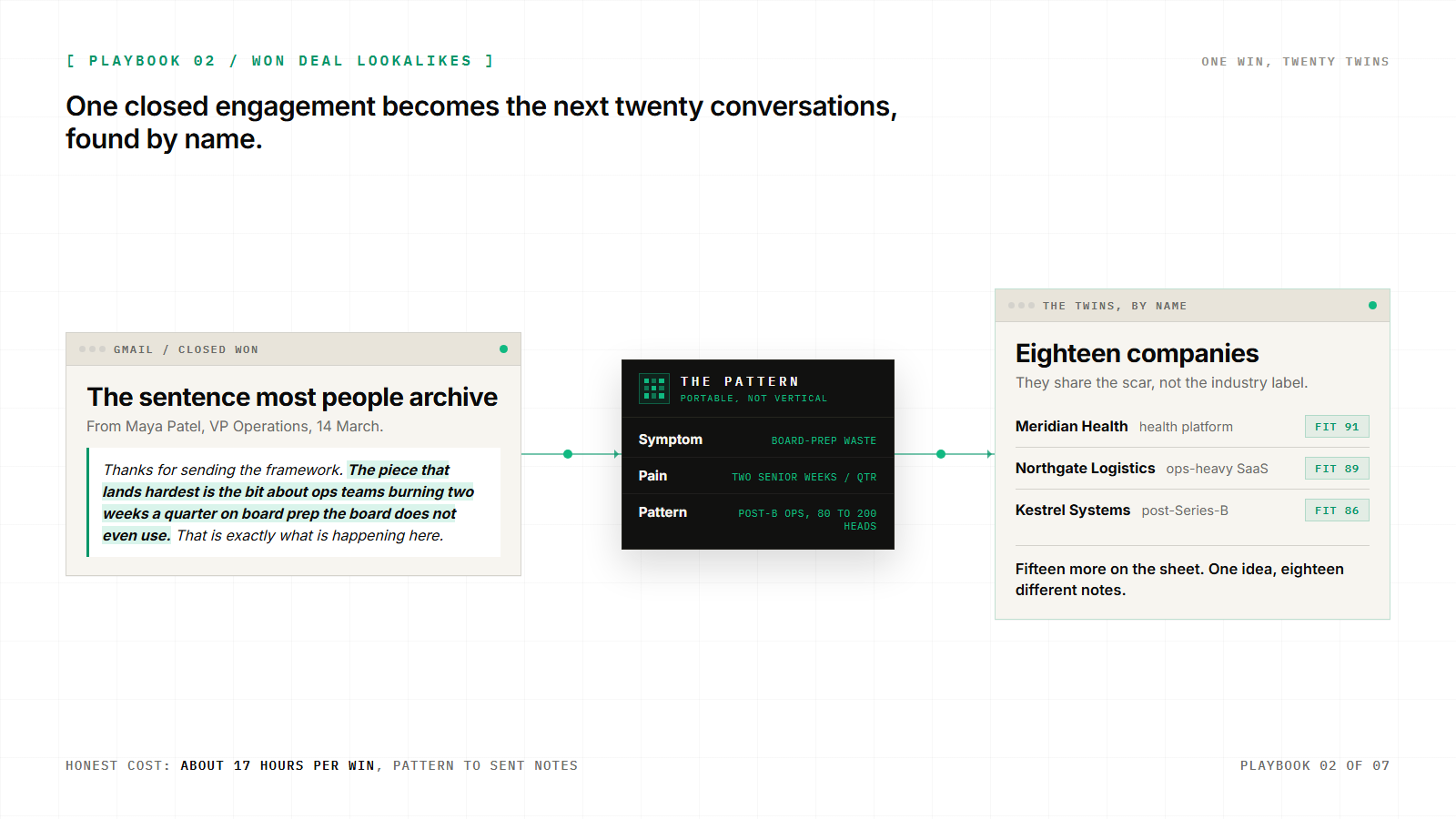
You won a great client last quarter and you delivered real value for them. Somewhere out there are twenty more companies suffering from precisely the same problem, who would hire you tomorrow if only they knew you existed. This playbook finds them by name, using evidence you already have in your sent folder.
Playbook 02 / one win, twenty twins
|
|
| Who it targets |
Buyers you have never met, at companies that share the problem pattern of a deal you already closed, not necessarily the same industry label. |
| The signal |
A won deal’s symptom language, distilled into a portable pattern (who hurts, what breaks, what size, what trigger). |
| Where it is visible |
Close emails, proposals, discovery notes, call recordings, then LinkedIn company search and people search for lookalikes. |
| Time cost |
About 17 hours per win once contact-finding and the address waterfall are included. ~70 hours a year acros |
Playbook 02: Won Deal Lookalikes
1,204 words
Move Inside one job posting there are four different playbooks
Open Inside one job posting there are four different playbooks
Playbooks 03 through 06
A company posting a senior full-time hire is broadcasting a problem out loud. Most operators read the headline, they need a Head of Marketing, and walk straight past it.
There are at least four different ways that same posting is a conversation for you, each one with its own angle, its own person to reach, and its own message. One LinkedIn jobs page is quietly holding four playbooks at once, and most people walk straight past all of them, because the only story they can see in a job advert is the one printed in the headline.
03 / Fractional Fit
They are hiring full-time for work you could deliver in two or three days a week. Their search takes ninety days. You can start in two.
04 / Sideways Opportunity
They hired a Head of X. They almost certainly need a Head of Y too. They just have not named it yet.
05 / Leadership Gap
They are hiring a Manager into a function with no senior leader above them. The CEO knows it. They are hiring at the wrong level to save m
Inside one job posting there are four different playbooks
644 words
Move Playbook 03: Fractional Fit
Open Playbook 03: Fractional Fit
Playbook 03 · New / hiring
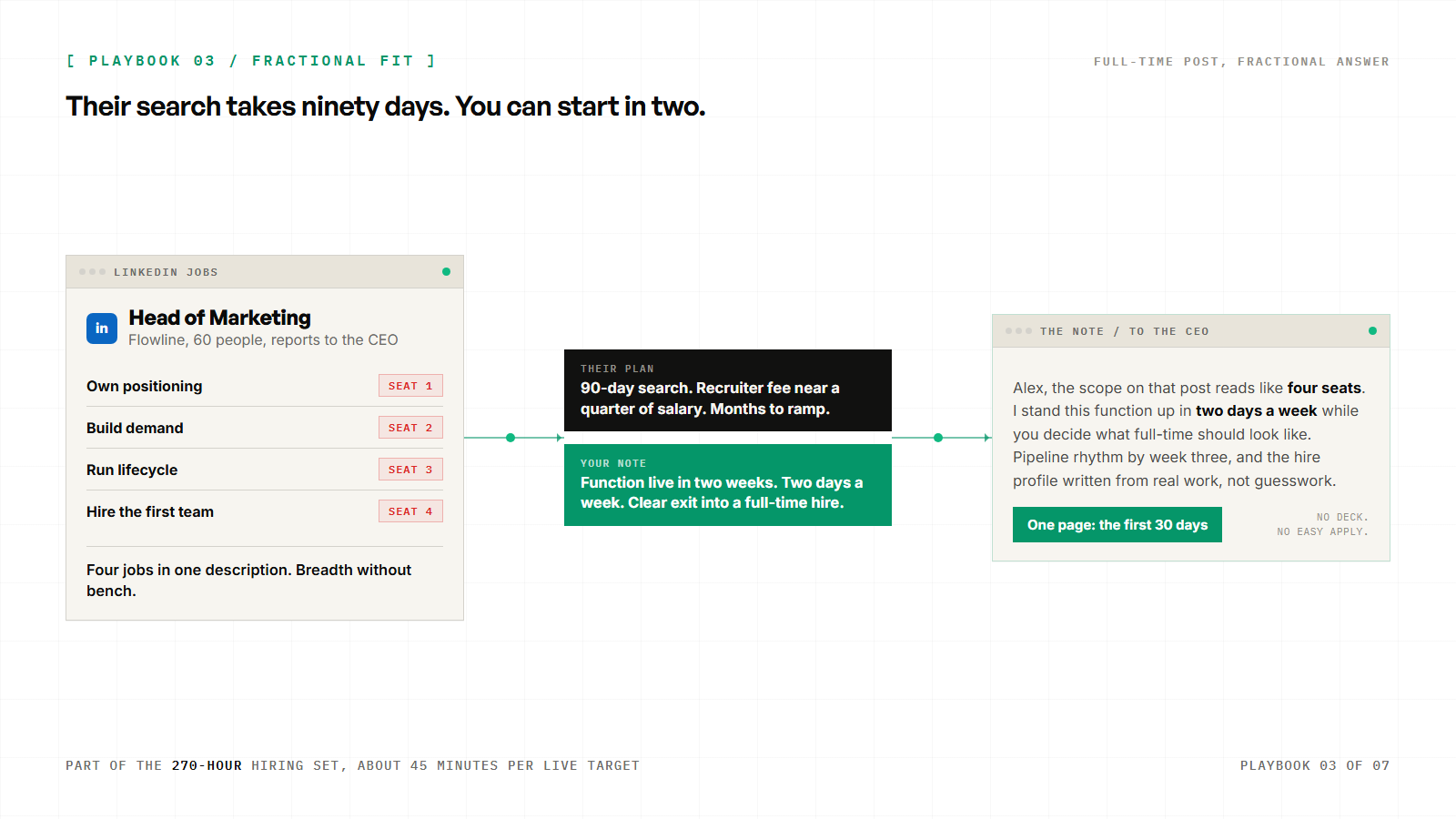
They are hiring full-time for work you could deliver in two or three days a week. Their search will take ninety days, and you could start on Tuesday. This playbook is how you make that offer without ever sounding like a rejected candidate.
Playbook 03 / full-time post, fractional answer
|
|
| Who it targets |
Usually the CEO or founder at a 30–300 person company posting the first senior hire in your function. |
| The signal |
Senior single-contributor role (Head of / Director / VP), reports to CEO/founder, broad scope that looks like four jobs in one job description. |
| Where it is visible |
LinkedIn Jobs, company careers page, occasionally a founder post that links the role. |
| Time cost |
Part of the ~270 hour hiring set. Per live target: ~45 minutes through the tradecraft pipeline once the row is a keeper. Plan 4–6 solid sends a week if this is your only hiring angle. |
How to run it
Step
Playbook 03: Fractional Fit
687 words
Move Playbook 04: Sideways Opportunity
Open Playbook 04: Sideways Opportunity
Playbook 04 · New / hiring
They have just hired a Head of X, which means they almost certainly need a Head of Y as well. The dependency is real, the buying mindset is already open, and nobody inside the building has named the second seat yet. This playbook is how you name it first.
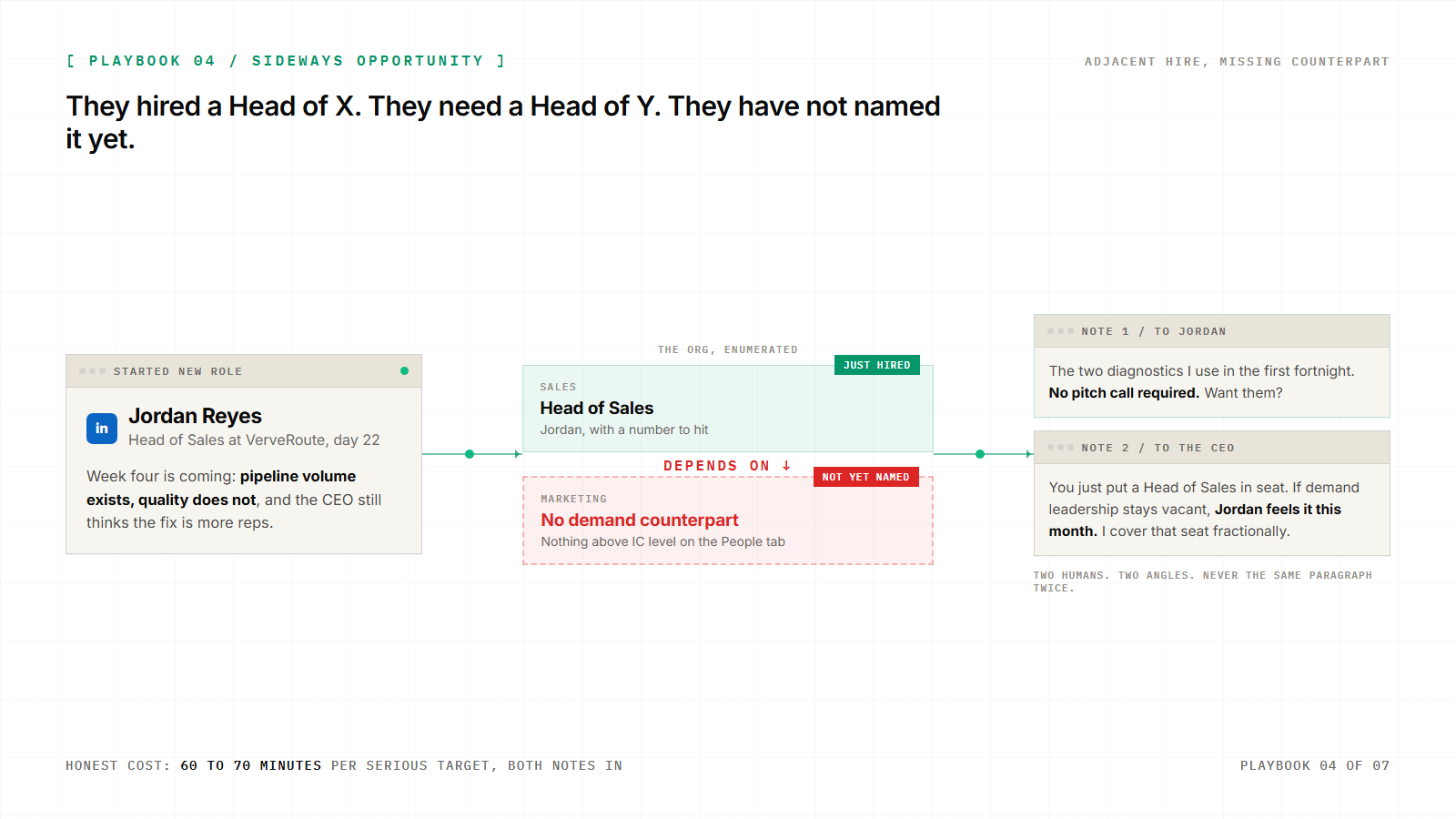
Playbook 04 / adjacent hire, missing counterpart
|
|
| Who it targets |
The newly hired adjacent leader (primary), and the CEO who approved that hire (secondary). |
| The signal |
A recent senior hire in a function that depends on yours, with no senior hire in your function visible on the org. |
| Where it is visible |
LinkedIn “started new position” posts, company People tab, Sales Navigator job changes, press or blog hire announcements. |
| Time cost |
Heavier than a single-touch hire playbook: two humans, two notes. Budget about 60–70 minutes per serious target once both waterfalls and both drafts are included (the tradecraft pipeline twice over, minus t |
Playbook 04: Sideways Opportunity
751 words
Move Playbook 05: Leadership Gap
Open Playbook 05: Leadership Gap
Playbook 05 · New / hiring
They are hiring a Manager into a function with no senior leader above it, which means the Manager is about to inherit a strategy they were never hired to own. The CEO usually knows this perfectly well, because hiring at the wrong level was the cost-saving plan. This playbook positions you as the missing layer instead of the casualty of it.
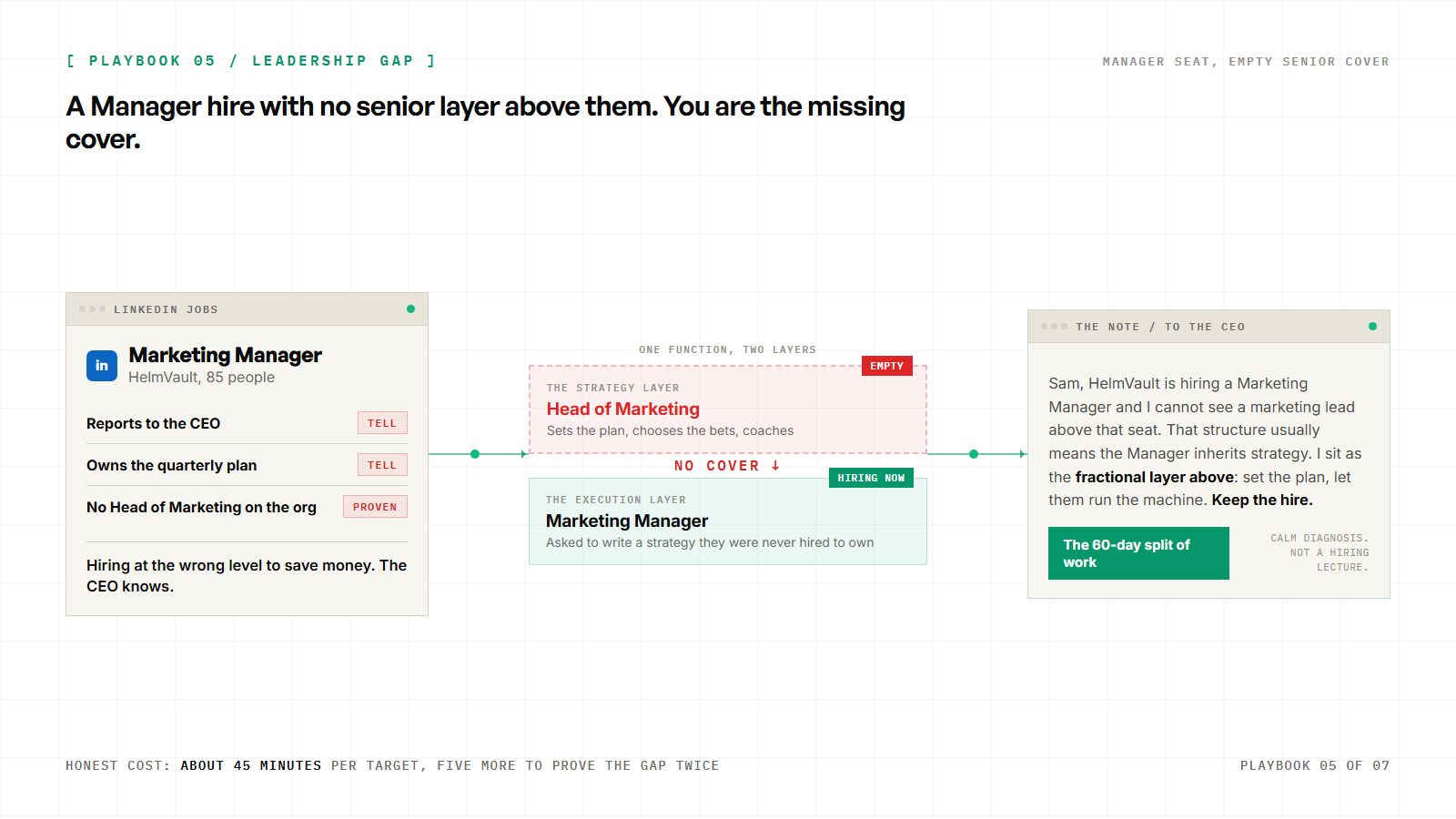
Playbook 05 / manager seat, empty senior cover
|
|
| Who it targets |
The CEO or COO who owns the hire. Not the manager candidate. You are the strategy layer above the seat they are filling. |
| The signal |
Manager / Senior Manager posting in your function, no VP / Director / Head of that function on the company LinkedIn, reports outside the function. |
| Where it is visible |
LinkedIn Jobs manager titles, company People tab empty at senior level, org clues in the JD (“report to CEO”). |
| Time cost |
~45 minutes per live target through the tradecraft pipeline, plus |
Playbook 05: Leadership Gap
624 words
Move Playbook 06: Outsource or Automate
Open Playbook 06: Outsource or Automate
Playbook 06 · New / hiring
They are hiring junior or admin headcount for repeatable work that a well-designed process, service, or tool could do for less. The hiring manager rarely sees the alternative until somebody shows it to them, and this playbook makes you that somebody.
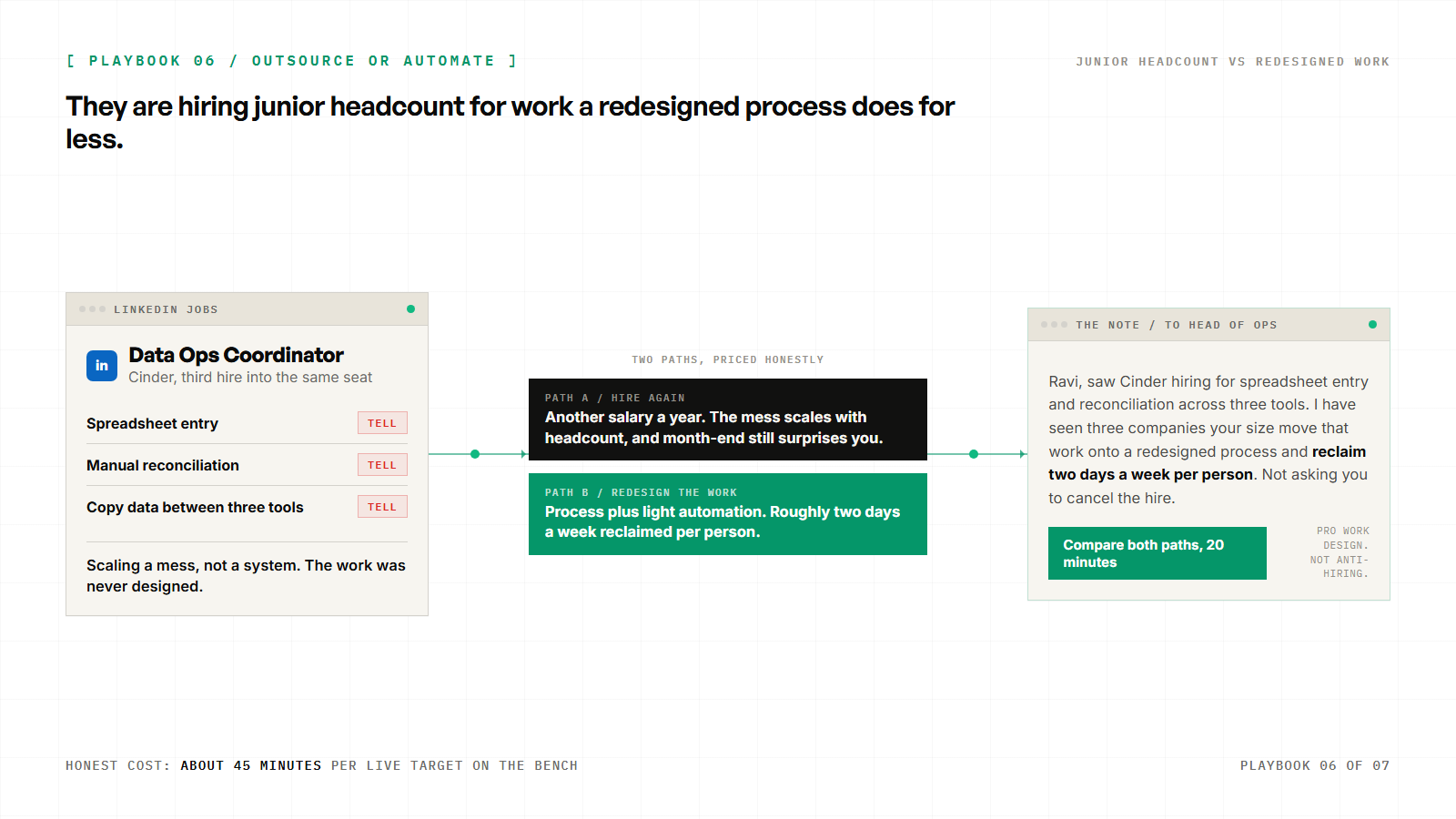
Playbook 06 / junior headcount vs redesigned work
|
|
| Who it targets |
The senior owner of the function: Head of Ops, Finance, CS, or the founder still wearing that hat. |
| The signal |
Junior / coordinator / clerk roles, JD language about spreadsheets, manual reconciliation, invoice processing, basic reporting, or repeated hires of the same seat. |
| Where it is visible |
LinkedIn Jobs, Indeed for some markets, careers pages, sometimes a founder complaining about “ops drag” in a post next to an open junior role. |
| Time cost |
~45 minutes per live target through the tradecraft pipeline. Screening is faster than on the senior playbooks. Trust still dies if |
Playbook 06: Outsource or Automate
586 words
Move Playbook 07: New In Role
Open Playbook 07: New In Role
Playbook 07 · New relationships
Someone has just started a target role within the last thirty days, carrying a fresh mandate, an unspent budget, and a vendor list that is still genuinely open. Reach them in month one and you become the default that everyone else gets compared against. Arrive in month three and you are the comparison.
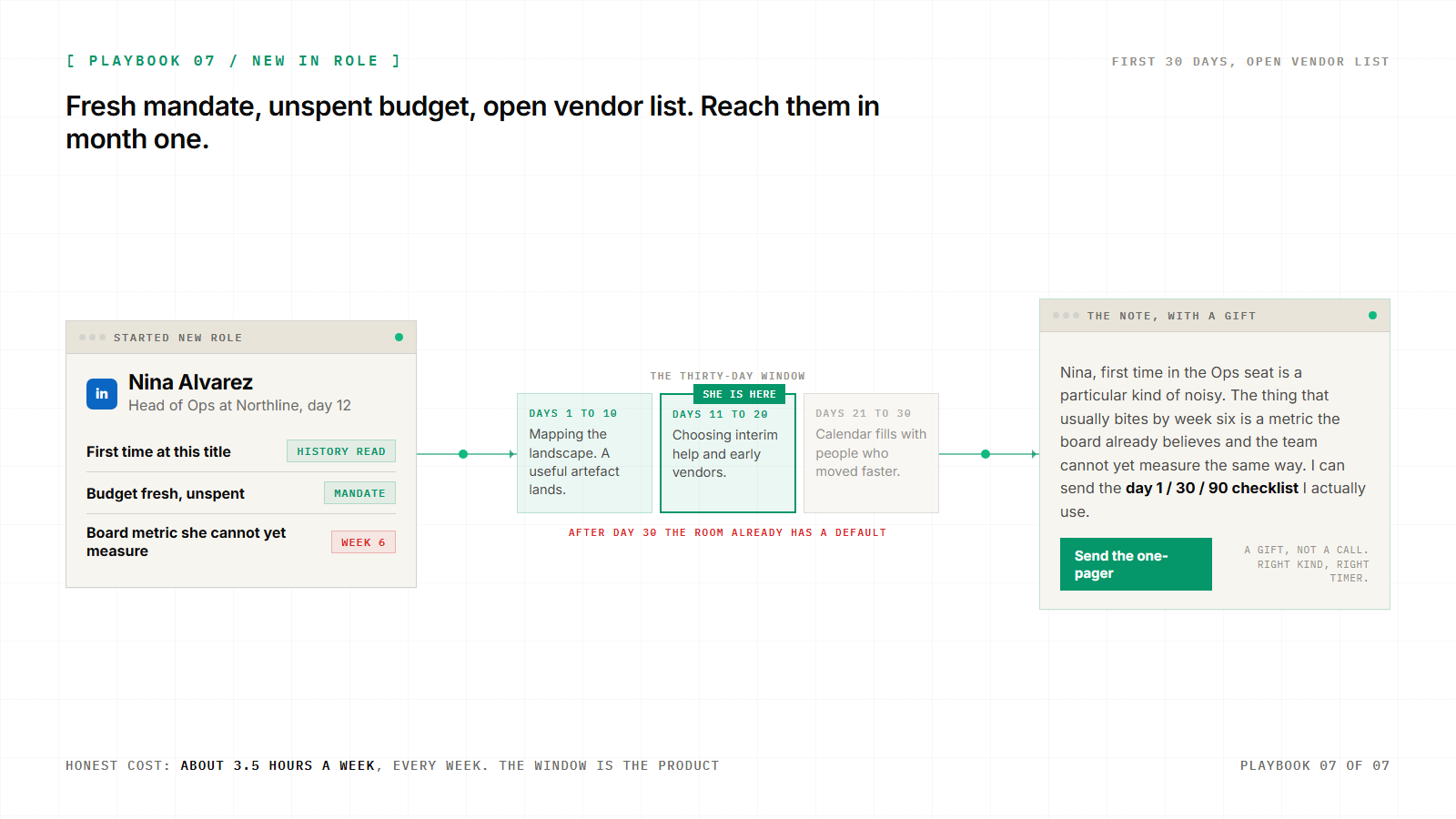
Playbook 07 / first 30 days, open vendor list
|
|
| Who it targets |
Newly appointed Heads, VPs, Directors, and sometimes CXOs in the seats that buy your work. Strangers until you write. |
| The signal |
Job change in last 30 days into a target title at a company that matches your client type. |
| Where it is visible |
LinkedIn “pleased to announce” posts, Sales Navigator job changes, company announcements, sometimes press. |
| Time cost |
~180 hours a year at a serious weekly cadence (about 3.5 hours a week). Watch, history read, waterfall, draft, send, one follow-up. The background read is still the |
Playbook 07: New In Role
1,084 words
Move There are more playbooks
Open There are more playbooks
Beyond the seven
The seven playbooks you have just read produce the biggest immediate impact for consultants and boutique consulting firms, but you should know that they are nowhere near the full set.
There are four more inside a single chapter on “Who’s Merging”: post-acquisition integration, pre-merger due diligence, carve-out and divestiture leadership, and management-buyout advisory. Each opens a different door in a market tilting more strategic every quarter. There are playbooks for dormant accounts you are quietly about to lose, for referrers who have gone unusually quiet, for the moment a client’s biggest competitor closes a funding round, and for the conversation patterns that signal a live deal is about to ghost.
The point of this book is not that you should run all twelve yourself. That is what a system is for. The point is that the conversations are already there, waiting for someone to surface them.
**If all you did was pick one of these seven and run it consistently for a year, your p
There are more playbooks
180 words
Move The tradecraft: running the playbooks by hand
Open The tradecraft: running the playbooks by hand
Tradecraft
You have now read all seven playbooks, and each one delegated its mechanics to this chapter. Here is why: every public-signal playbook runs on the same underlying pipeline. The signal arrives, the junk is stripped out, the search expands, the right human is found, an address is obtained and verified, the note goes out, and the work is logged. This chapter specifies that pipeline once, honestly, with the software named at every stage, so the playbooks themselves could stay about judgement.
If you skip this chapter, the sample messages in the playbooks will still read well, but you will not actually know how to execute, and the gap between those two states is where most good intentions die. Read it with one real job posting or role change open beside the book, because every stage below is written to be runnable without guessing.
Minutes you will feel
Setup is about an hour once. Steady state for a serious hiring week is roughly ninety minutes of monitoring plus about forty-five min
The tradecraft: running the playbooks by hand
3,816 words
Move The honest cost of doing it by hand
Open The honest cost of doing it by hand
The math
Any single playbook puts real meetings on your calendar. The shift happens when several run together, because each catches a different shape of conversation in a different week.
Seven shapes / stacked annual hours (one client type)
| Playbook |
Hours a year by hand |
| 01 Network Sprint |
~96 hrs |
| 02 Lookalikes |
~70 hrs |
| 03–06 Hiring set |
~270 hrs |
| 07 New In Role |
~180 hrs |
Seven playbooks by hand against a single client type: roughly 616 hours a year once contact-finding and the address waterfall are included (96 + 70 + 270 + 180). About 77 working days. A full second job. Stage minutes live in the tradecraft chapter.
Network Sprint keeps you present with the people who already trust you. Won Deal Lookalikes turns every closed engagement into the next twenty. The four hiring playbooks catch the moment a company has approved a budget and signalled intent in public, before anyone else shows up to compete. New In Role catches the brand-new buyer in
The honest cost of doing it by hand
606 words
Move Where to start, and what Nynch is for
Open Where to start, and what Nynch is for
Where this leaves you
Own the next conversation
Every playbook here is something you can start today. Where you start depends on what you have.
- Years of relationships gone cold → start with Network Sprint.
- Network feels thin → start with a hiring playbook. Public budget, public need, stranger you are allowed to help.
- A strong win in the last two quarters → start with Won Deal Lookalikes.
- You sell to people who change seats → start with New In Role.
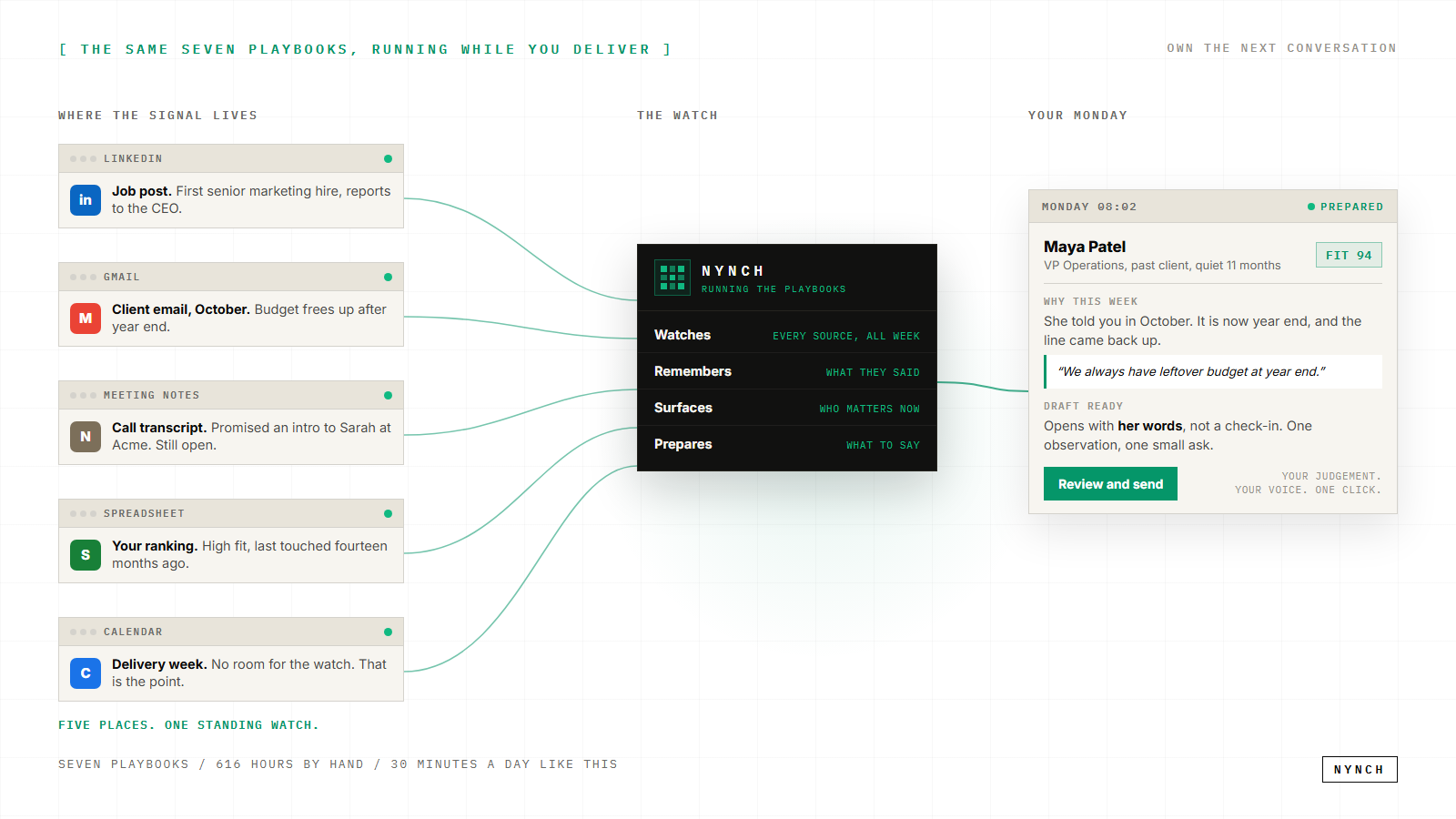
Either way, you will get further by hand than you think, right up until the time it takes catches up with you and the spreadsheet quietly stops being maintained. You know it will. It always has.
That failure mode is not a moral weakness. It is the surfacing gap wearing a different mask. The conversations keep appearing. Your attention returns to delivery. The watch stops. Famine returns on schedule.
What Nynch does with the same seven playbooks
Nynch is the AI CRM for consultants and
Where to start, and what Nynch is for
531 words