Playbook 01 · Existing relationships
There are twelve hundred people in your network, and perhaps sixty of them are ready for a real conversation this quarter. The trouble is that you have not spoken to most of them in over a year, and you have no way of knowing which sixty they are. This playbook turns the address book you already own into a live ranking of who matters right now, why they matter, and what you would open with.
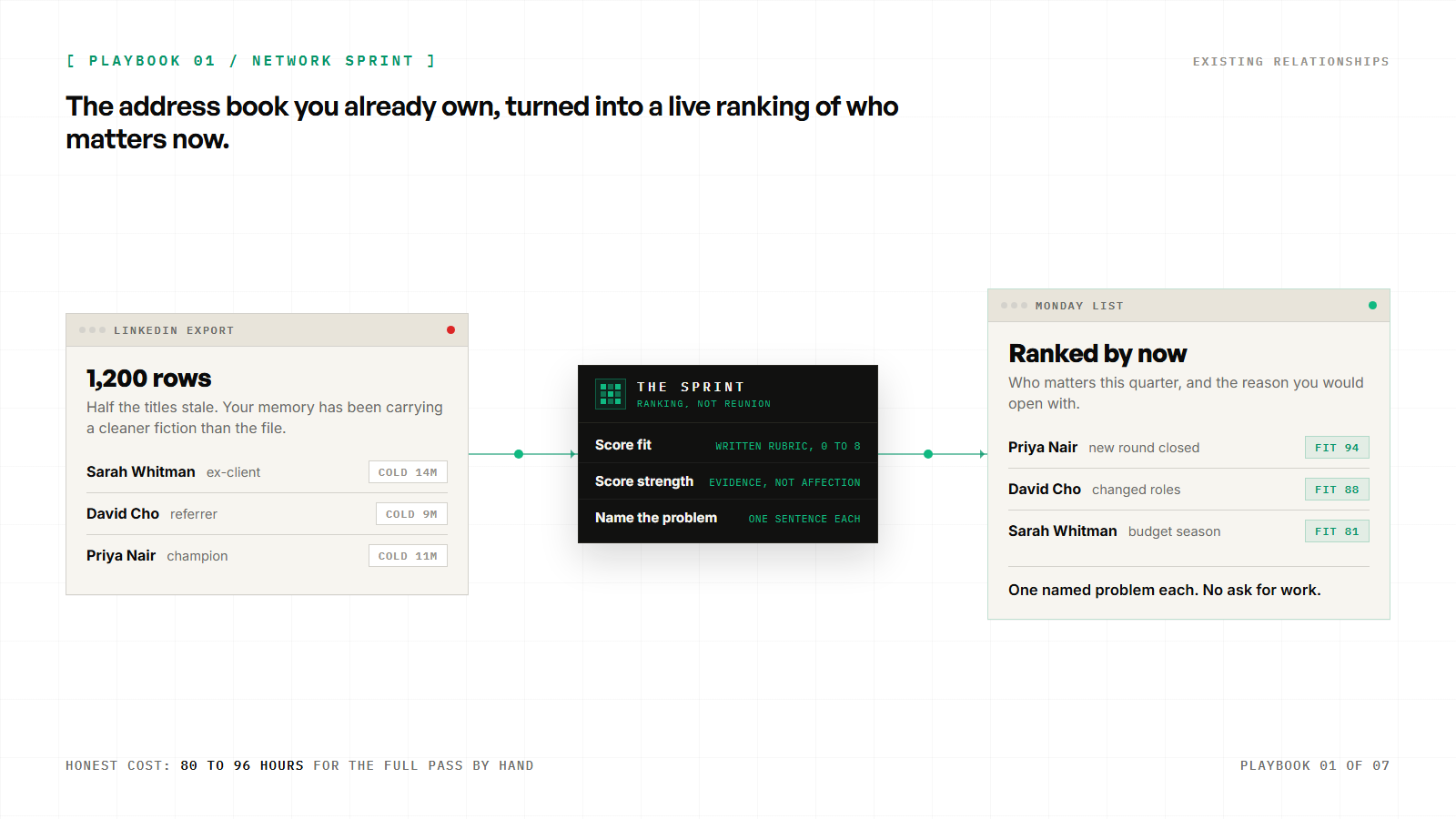
Playbook 01 / existing relationships
| Who it targets | Past clients, referrers, peers, and warm contacts already in your LinkedIn graph or inbox who match your ideal client or sit one step from one. |
| The signal | High fit + relationship decay. They still look like a buyer (or a path to one), and you have gone quiet long enough that recency has died. |
| Where it is visible | LinkedIn Connections.csv, your Gmail search history, calendar of past meetings, and any notes you still have from past work. |
| Time cost | 80–96 hours for a network of ~1,200 if you run the full ranking properly, then about 12 working days a year if you re-run quarterly. |
Why this playbook exists
The relationships you already have are worth more than the ones you have not built. A continuous audit pays you in conversations that never had to be cold, the only kind that protects status instead of spending it. Operators drop this playbook not because they are careless, and not because ranking and writing are beneath them. They drop it because the default stack was a sales CRM and a vague instruction to “stay in touch,” which turns into admin with no signal and no sentence worth sending. This playbook replaces that with a ranking and a real angle. It is the fastest path to three to five real conversations if you have any history at all.
How to run it
Step 01: Export your LinkedIn connections.
Settings → Data privacy → Get a copy of your data → Connections. Wait up to 24 hours. Download the zip. Open Connections.csv. You now have every first-degree connection LinkedIn will give you. Expect mess: half the rows are missing titles, a third list a company that was true two years ago. That mess is the point. Your memory has been carrying a cleaner fiction than the file.
Step 02: Write the ideal client as a scoring rubric, not a vibe.
Four fields on one page: title patterns you sell to, company size band, industry or problem domain, and a trigger event (funding, new leader, expansion, cost pressure). Score each field 0–2. A perfect fit is 8. This is the work you have carried in your head for years and never written down. Until it is written, you will re-litigate it on every row and the afternoon will die.
Step 03: Score each contact for fit.
Work in batches of 40. Open the profile, check title and company, mark green (6–8), amber (3–5), or red (0–2). Do not write outreach yet. By contact 80 the rubric will start to drift. By 200 the energy is gone. Stop. Pick it up next session. Red rows can be archived without guilt. The playbook is a ranking, not a reunion tour.
Step 04: Score the greens and ambers for relationship strength.
Four questions only: When did you last speak? Have they hired you or referred you? Would they take a call from you without wondering who you are? Was the last contact substantive or performative? Warm, cool, or polite-stranger. That number lives in your head and nowhere else until you force it onto the sheet.
Step 05: Predict the problem each high-fit person is probably facing.
Use public crumbs: a hiring freeze post, a board that wants a number, a peer who just got cut, a reorg nobody has announced yet, a product launch that will break their process. If you cannot name a plausible problem in one sentence, drop them down the list. You are not ready to message them without becoming “just checking in.”
Step 06: Write the outreach. One person. One angle. No ask for work.
A real message names the problem, brings an angle they had not considered, and asks for nothing more than a short conversation or permission to send something useful. Different every time. Cap yourself at five to eight messages per working day so the quality holds. Send, log, and follow up using the shared rules from the tradecraft chapter at the back: channel order, the one-follow-up ceiling, and the same-day log. Prefer the channel you already use with them. LinkedIn is fine when you have no email.
What to say
Past client / gone quiet 11 months / email
Subject: The board-prep waste we fixed at Northline
Maya, I still think about the line you used when we closed out: ops burning two weeks a quarter on pack the board never opens. I have seen that pattern three more times since. Curious whether it is still true on your side, or whether the problem moved.
No pitch. Twenty minutes if useful. If not, ignore this and I will not chase.
Sam
Warm peer / possible referrer / LinkedIn note
James, saw you posted about the reorg. When we last spoke you were still protecting the advisory bench from becoming a delivery factory. If that fight is live again, I have a one-page pattern from two similar transitions that might save you a week. Want it?
~96 hrs / year. Full ranking on ~1,200 connections, re-run quarterly. First pass is the heavy one: export, rubric, score, write. Later quarters are maintenance if you keep the sheet alive. Most people do the first pass once and never return, because feast mode takes the desk back.
How this playbook fails
- You score everyone as green because saying no feels rude. The list becomes unusable.
- You send “hope you’re well” notes. Reply rates die and you blame the playbook.
- You try to finish 1,200 rows in one weekend. Quality collapses after row 150.
- You never re-run after quarter one. The ranking rots while you deliver.
- You message people who only ever liked your posts. Polite strangers are not warm.
The sheet that keeps the playbook alive
Use the shared sheet described in the tradecraft chapter, and add only the Network Sprint fields it does not already carry:
- Fit score (0–8) from the rubric
- Relationship (warm / cool / polite)
- Last real contact (date and channel, not a like)
- Predicted problem in one sentence
Sort weekly by fit descending, then by relationship strength, then by how stale the last contact is. Your Monday list is the top ten you have not contacted in ninety days. That is the whole operating system. Anything fancier is procrastination dressed as infrastructure.
What happens after they reply
A yes to a short conversation is not a pitch meeting. Open with the problem you named. Ask what is true for them now. Only then, if it still fits, describe how you have solved it and what a first engagement would look like. If they say “not now,” ask when would be sane to check back, put that date in the sheet, and keep the relationship warm with occasional substance rather than calendar spam.
When not to start here
If your honest first-degree graph is under a few hundred people and almost none of them buy what you sell, do not punish yourself with Playbook 01. Start with a hiring playbook. Build conversations from public signals. Come back to Network Sprint when there is something worth ranking.