Playbook 02 · New relationships
You won a great client last quarter and you delivered real value for them. Somewhere out there are twenty more companies suffering from precisely the same problem, who would hire you tomorrow if only they knew you existed. This playbook finds them by name, using evidence you already have in your sent folder.
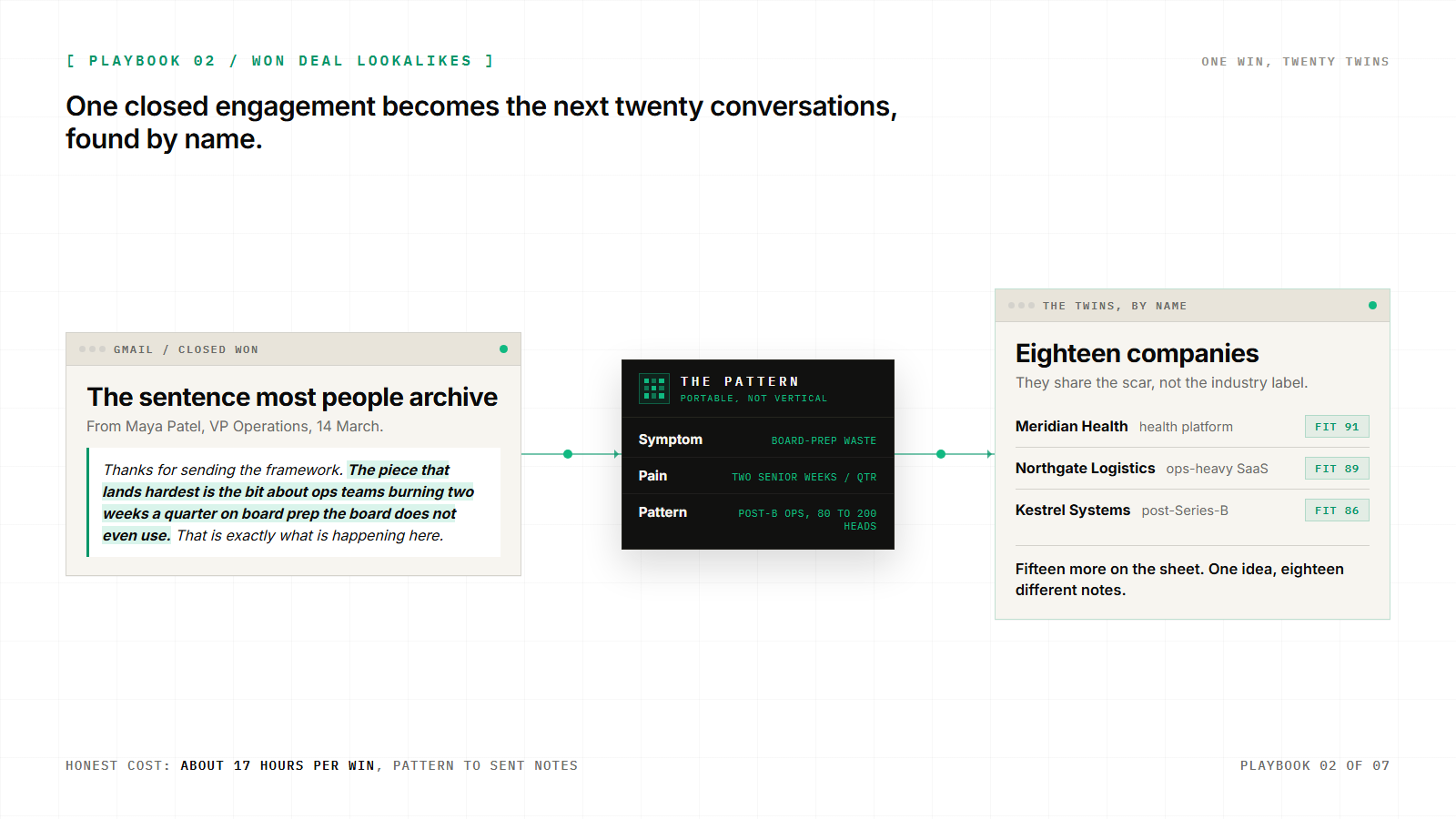
Playbook 02 / one win, twenty twins
| Who it targets | Buyers you have never met, at companies that share the problem pattern of a deal you already closed, not necessarily the same industry label. |
| The signal | A won deal’s symptom language, distilled into a portable pattern (who hurts, what breaks, what size, what trigger). |
| Where it is visible | Close emails, proposals, discovery notes, call recordings, then LinkedIn company search and people search for lookalikes. |
| Time cost | About 17 hours per win once contact-finding and the address waterfall are included. ~70 hours a year across four real wins. |
The sentence most people archive
The whole playbook starts with one sentence buried in a close email. When a client writes something like this, most operators feel good for a second and file it:
Gmail / closed won / Acme Software
From Maya Patel / VP Operations / 14 March
Thanks for sending the framework. The piece that lands hardest is the bit about ops teams burning two weeks a quarter on board prep the board doesn’t even use. That’s exactly what’s happening here. The CFO said roughly the same thing on Tuesday. I’d like to bring you in for a working session with the leadership team.
Look at what is actually inside that sentence, because every part of a portable pattern is sitting there waiting to be extracted. The symptom is board-prep waste. The pain is senior time being burned on a document nobody trusts. The pattern is a post-Series-B operations team of roughly 80 to 200 people. Anywhere those three things live together, the same conversation will close, because the problem does not care what industry it lives in. There are twenty more companies with that precise problem who would hire you right now if they knew you existed, they are findable by name, and the proof that they need you is already sitting in your sent folder. The impact of archiving that email instead of mining it is twenty conversations that never happen.
How to run it
Step 01: Pull every artefact from the won deal.
Search Gmail for the company. Open the first twenty threads that matter. Re-read discovery notes, the proposal, the kickoff transcript if you have one. You are not looking for praise. You are looking for the words they used before you translated their pain into your offer.
Step 02: Distil symptom, pain, and structural pattern.
Three lines on paper. Symptom: what they said was broken. Pain: what it cost them in time, money, or risk. Pattern: size, stage, function, and trigger that made the problem acute. If you cannot fill three lines, you do not have a portable win yet. Pick a different closed deal.
Step 03: Look outside their industry on purpose.
If your client was a fintech, who else has the same symptom? A health platform at the same revenue. A logistics SaaS under the same pricing pressure. The easy move is to pitch the same vertical you just left. The better move is to follow the symptom, because the problem travels and the industry label does not.
Step 04: Build the lookalike list to about eighteen companies.
LinkedIn company search, filtered by size, region, and growth signals you can see. Save forty. Eyeball each. Drop the mismatches. You want eighteen you could defend in a room, not eighty for a spray sequence.
Step 05: Source the right person at each company, then get an address.
Run the tradecraft pipeline: enumerate the org, walk the title ladder for whose problem the symptom is, one primary per company. Then the address waterfall. Skip people who started last week or whose posts suggest they are leaving. Playbook-specific cue: CEO at the small ones, CFO, COO, or Head of Ops at the larger when the pain is operational.
Step 06: Write the same opening eighteen different ways, then send and log.
The story that closed the won deal works on the lookalikes, but their funding round is different, their last post is different, their product is different. You personalise one idea, eighteen times. Use the client’s symptom language where you can without naming the client if confidentiality requires silence. Specifics beat “I help companies like yours.” Channel order, one follow-up, same-day log: tradecraft stage 6 covers all three.
What to say
Cold to a lookalike VP Ops / LinkedIn
Priya, I work with post-Series-B ops leaders where the board pack still burns two senior weeks a quarter and nobody trusts the numbers in the room. Just finished that exact problem with a company your size. Not pitching a project. If board prep is a tax on your team this quarter, I can send the one-page version of what we changed. Useful?
~70 hrs / year. Assumes four wins worth running the playbook against. About four hours to extract the pattern, two to build eighteen companies, then finding people, the waterfall, drafting, sending, and one follow-up on each (tradecraft stages 4 to 6, with no job-board expansion needed). Roughly seventeen hours per win, ~70 a year. Most operators do it once, on the first win, then never come back.
How this playbook fails
- You copy the industry instead of the problem. You get a vertical list with no shared pain.
- You name the previous client without permission. Trust dies before the call.
- You build eighty companies and write nothing. Lists are not pipeline.
- You message “founders” generically when the buyer is a VP with a live scar.
- You run it on a weak win. Thin proof produces thin messages.
Confidentiality without gutting the story
You can almost always use the symptom without naming the client. “Post-Series-B ops team burning two senior weeks a quarter on a board pack nobody trusts” is specific and portable. “Acme Software’s VP Ops said…” is a breach unless you have a written case study right. When a prospect asks who you did it for, answer with what you are allowed to share: industry band, size, outcome metric, and whether a reference call is possible later under NDA. Do not invent a logo to win a first meeting.
When to run it again
Every meaningful win deserves a lookalike pass within two weeks of close, while the language is still sharp in your head and the artefacts are easy to find. Do not wait for quarter-end “BD time.” By then you will have forgotten the sentence that made the deal real. If you close four substantive engagements a year, that is four passes. If you close one, run that one hard and deep. One well-extracted pattern beats four shallow vertical lists.