The Power of Interesting: How One LinkedIn Scroll Led to an $18K Project

Peter O'Donoghue
Business Development Expert
Every consultant knows they should be "present" in their marketplace. But what does that actually mean?
I'm about to show you two real examples where being present - truly present - led to consulting projects. More importantly, I'll show you exactly how to replicate these results.
You know what I'm talking about: You've probably heard advice like "engage on LinkedIn" or "network consistently." But then you automate your LinkedIn outreach and install feed cleaners to "save time and bandwidth."
Here's the uncomfortable truth: Those "time-saving" tricks are removing you from the marketplace and costing you money.
Let me prove it.
The $18K Project That Started With a Scrolling Break
It was February 2024. I was doing something most consultants consider "wasting time" - actually reading my LinkedIn feed.
An ad caught my eye about strategy coaching for retiring executives.
Most consultants would have:
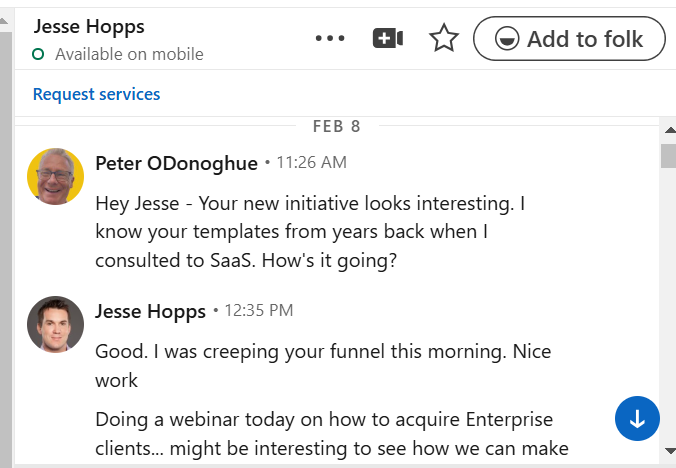
What follows are screenshots of the real LinkedIn chat messages that started a conversation - from cold and ended in a $18,000 mini consulting project. My client from Demand Metric is totally OK with these details being shared.
"Interesting..." I thought.
"I should reach out to those guys and start a conversation."
I could have spent hours debating whether they were a potential competitor, would they need me to help them or even how they would react to my outreach. None of that would be productive.
Personally, I find that speed of action stops that inner Gremlin taking over.
So about 5 minutes after I saw their advert, I sent this message:
We had some back and forth chat, and then it went quiet. So I gently continued the conversation.
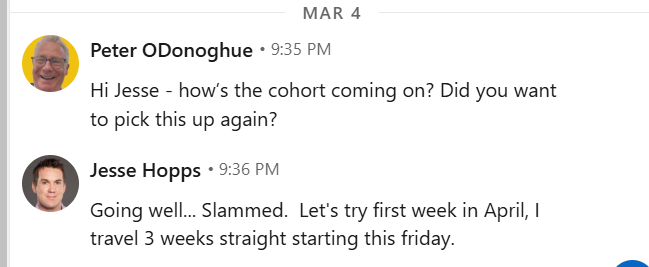
I liked the proposition they were taking to the marketplace as I had identified it as a gap for many of the consultants I had worked with. They (Demand Metric) had a 20 year track record creating frameworks, playbooks and consulting models to mid-market and enterprise clients and wanted to license their IP to more consultants.
Where they had a gap was content and frameworks to enable new consultants to get clients. I knew I could fill that gap quicker and more cost effectively than them creating it on their own. So I knew it was in their best interest if they worked with me.
The Follow-Up
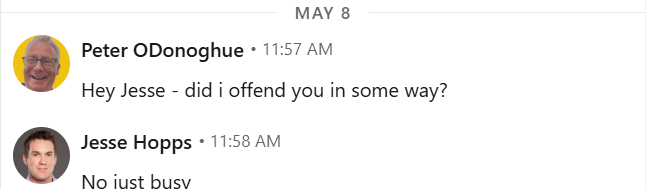
And then it went quiet. So I gently continued the conversation:
We set up a time to call and I took the initiative of providing massive value in advance and giving Jesse some of my best ideas ahead of the call.
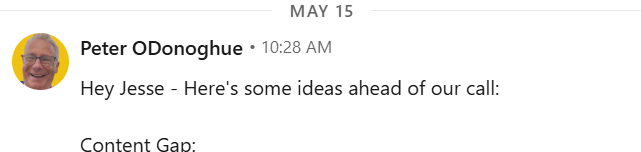
Many closed minded people might consider this a risk, but for me it was an upfront proof of value - all of which they could have done without me if they were that way inclined.
Jesse liked the ideas.

Want to implement this in your consultancy?
Book a free diagnostic to see where your revenue is hiding.
We had a good call and it was clear to me that Jesse was going through a period of change in his business and had a lot on his plate. He had a confused mind with lots of competing priorities which made it difficult for him to make a decision on the offer I had presented.
I'm not 100% sure how we arrived at the next step but we did. I set up a series of weekly calls that went for around 4 weeks. It was diarised with no charge and no agenda.
In those calls, I let Jesse talk (sometimes vent) and I listened. I probably spoke around 10% of the call. I didn't push my offer but just acted as a sounding board.
And the funny thing is, we approached the last diarised call and I was about to start a conversation that I'd not diarise any more calls but before I did Jesse said:
"Hey Pete - I'm ready to go ahead with your offer now"
And later that day we took care of payment number 1 - almost 6 months after my first outbound message.
What followed was a hugely enjoyable piece of work that was a huge success. Jesse's clients got great results and put frameworks in place to win new revenue for them and the network of consultants.
The Main Learning Points From This Example
Key Insight #1: Speed Beats Perfection
Within 5 minutes of seeing that ad, I had reached out. No complex strategy. No overthinking. Just genuine curiosity and quick action.
Key Insight #2: Persistence Without Pressure
Notice how the conversation went quiet multiple times? Instead of giving up, I maintained gentle, value-focused follow-ups.
This Could Never Be Repeated - Right?
This example is so random that you'd probably imagine that it could never be repeated? Wrong.
You'd be amazed what can happen when you are present and tuned into opportunities.
In Nov 24, I was scrolling LinkedIn and saw an announcement post of a new service aimed at Consultants.
"Interesting..." I thought. "I should reach out to those guys and start a conversation"
On the 17th December I had a 2nd call with this company and it's extremely likely that in Q1 2025 they'll become a client for the EXACT same offer that I ran with Demand Metric.
All I did was be present in my market.
Example 2: The Consulting Example To Enterprise
Way back in June 2014 I was scrolling LinkedIn and saw an advert which peaked my curiosity. At that time I was training and consulting to Enterprise technology and SaaS. There was a relatively new outbound business development motion off the back of innovations coming out of the Salesforce organization.
One of the leaders of this model wrote a book called 'Predictable Revenue' which is now known as the bible for the rapid GTM playbook of SaaS. Back in 2014 though it wasn't that well known.
Here was an advert from a company I didn't know advertising a free download of a section of this book. It peaked my interest immediately.
"Interesting..." I thought. "I should reach out to those guys and start a conversation"
About 10 minutes later - I had sent 4 emails to senior people in the advertising organization.
I had no idea why they were running ads for someone else's book BUT I knew enough about my Industry to be curious to find out why.
The Eagle eyed amongst you will spot that I sent the same email to 4 different people in the same organization, on the same day. This concept is called 'multi threading' and works on increasing the possibility of at least 1 person replying and beginning a dialogue.
I can't quite remember exactly how many responded but I have screenshots of 2 responses - so at least 2! And these weren't junior people. These were all C-Level executives.
What I discovered was that they were a customer service telecoms application within the Salesforce ecosystem. They were now expanding out into the sales vertical and wanted content to feed their content first marketing model.
"Hmmm" I thought "I could help fill that gap"
I seem to remember that about 7 days later I had a purchase order for around £7,000 to write a number of content pieces for them. They have since been acquired by Vonage but some of the work we did together is still live on the internet on the Vonage website.
The Main Learning Points From This Example
Being present on LinkedIn and having a 'raging' curiosity created this revenue from scratch. There is no doubt in my mind that if I hadn't seen the ad and proactively reached out, then I'd never ended up working with this client. This deal was created 'out of thin air'.
Dig your well before you are thirsty: The author Harvey MacKay wrote a great book called 'Dig your well before you are thirsty' where the main concept was building your network before you need it. In this example I had built my skills before I needed them. Back in 2014 it wasn't as easy to get people's email addresses, but I knew exactly how to do it. I already had email templates part written which allowed me to create that outbound email in under 2 minutes. Because of those skills, I went from the moment of curiosity to email validation and outbound email written and sent in under 10 minutes.
If I had to make a note of it and go and learn those skills later then there would be little chance of me ever sending that email. Ask yourself - what skills do you need in 2025 that you can build before you need them?
Your 5-Minute Action Plan
1. Remove all LinkedIn automation tools today - become present and engaged in your marketplace
2. Set aside 15 - 30 minutes daily for actual feed reading and engaging
3. Create your "curiosity trigger list" - what makes you say "Interesting..."?
4. Draft three ready-to-go outreach templates - LinkedIn messages or email
5. Practice finding decision-maker emails for one company so you have the skills ahead of when you need them
Remember: The best opportunities don't announce themselves. They whisper "Interesting..." and wait to see who's actually listening.
Most experienced consultants struggle with consistent lead generation despite having valuable expertise. The reason is because they rely too heavily on automation and passive strategies that create distance between them and their potential clients.
When this happens, they miss the "Interesting..." moments that could lead to significant projects. Until all of a sudden, they're in a feast-or-famine cycle, desperately seeking work when the pipeline runs dry.
The best solution is proactive business development that creates genuine connections with your marketplace. This approach to LinkedIn engagement and meeting productisation is the single most effective way to build a steady stream of right-fit clients.
If you're looking for support with this, I offer coaching and accountability programs and fractional business development services to help consultants implement these strategies consistently.
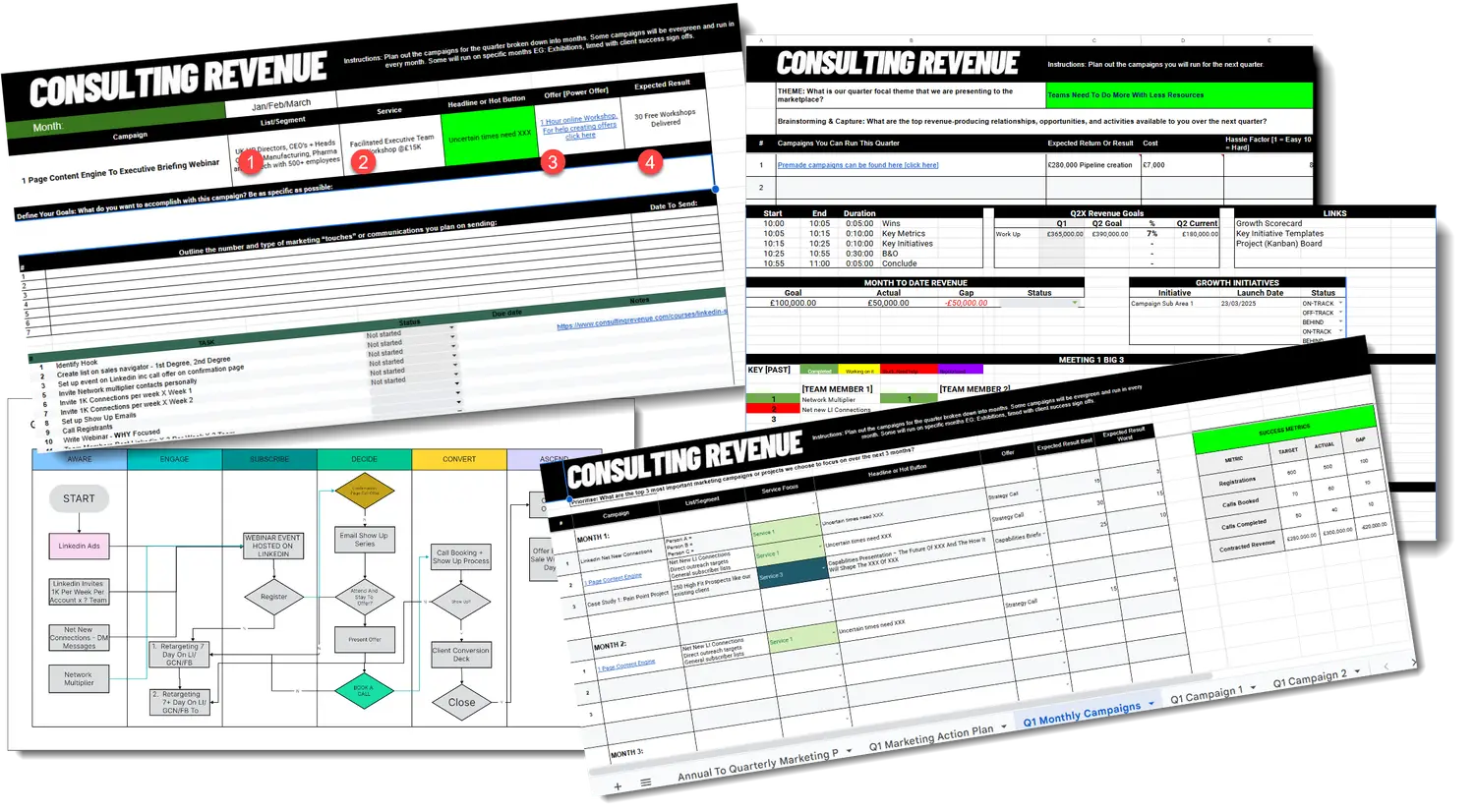
Build a BD System That Runs Without You
Download the Revenue Engine Builder. A strategic and tactical framework for building a repeatable, predictable business development system inside your consultancy.